



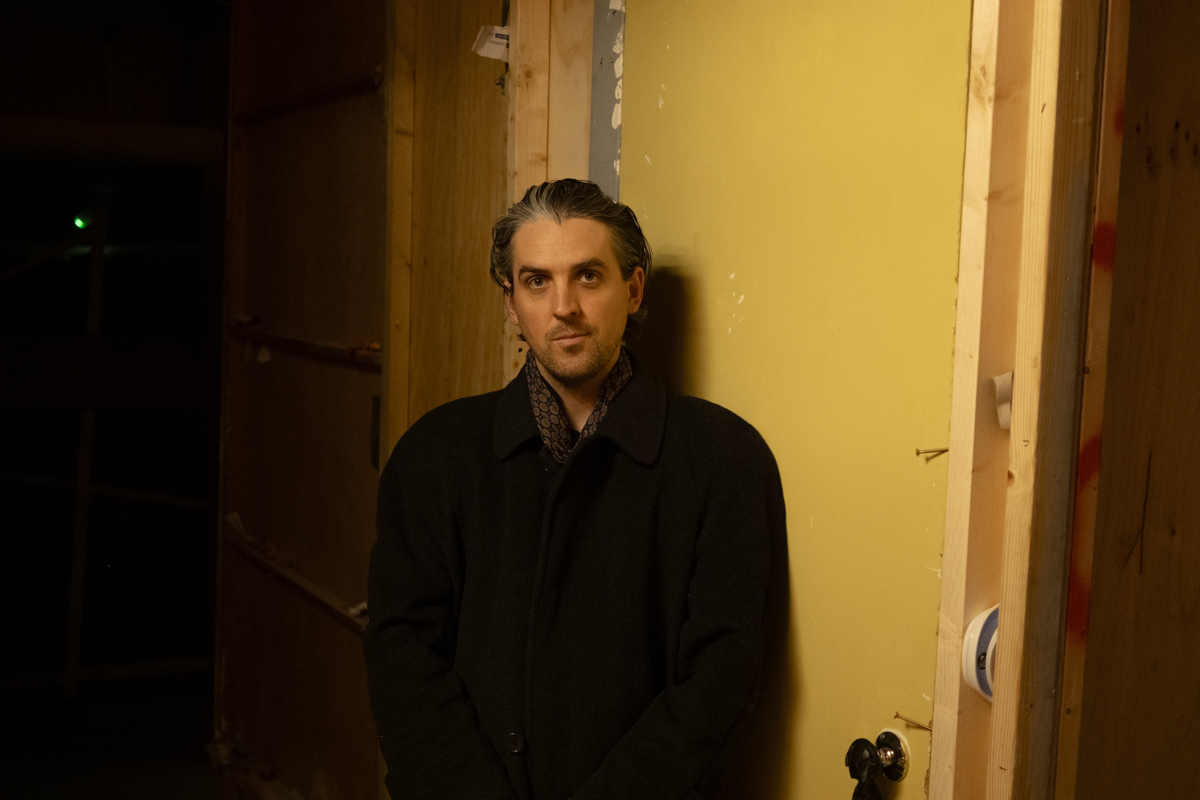
Hoy conversamos con Rory Mullen en Londres, donde presenta On the Verge of Want. Su práctica, situada entre la escenografía y la instalación, explora la tensión entre acceso y restricción, realidad y artificio.
A través de seis habitaciones móviles que no pueden habitarse, el artista construye espacios que se dejan ver solo parcialmente, activando una experiencia física e inquietante para el espectador.
Rory Mullen y la arquitectura imposible de habitar
Por Christina Grace Roig
Hay un momento, justo antes de la asimilación, en el que un espacio se resiste a ser comprendido. Al entrar en On the Verge of Want, uno no se encuentra con objetos sino con condiciones: oscuridad, luz dispersa y un leve murmullo sonoro.
La exposición no se revela de inmediato. Más bien, se contiene, generando una ligera desorientación, la sensación de haber llegado demasiado pronto o quizá a un lugar al que no se debía acceder del todo.
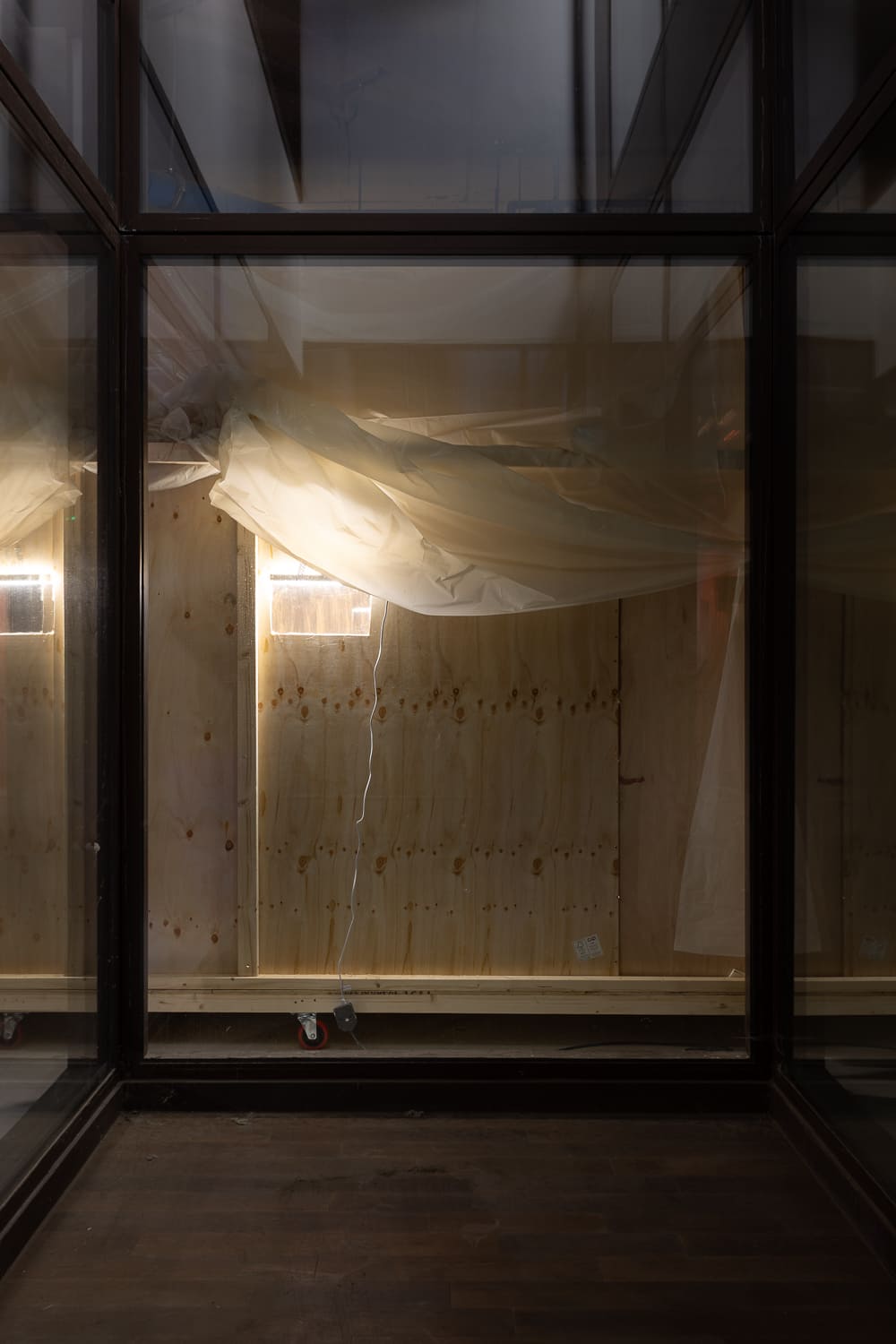
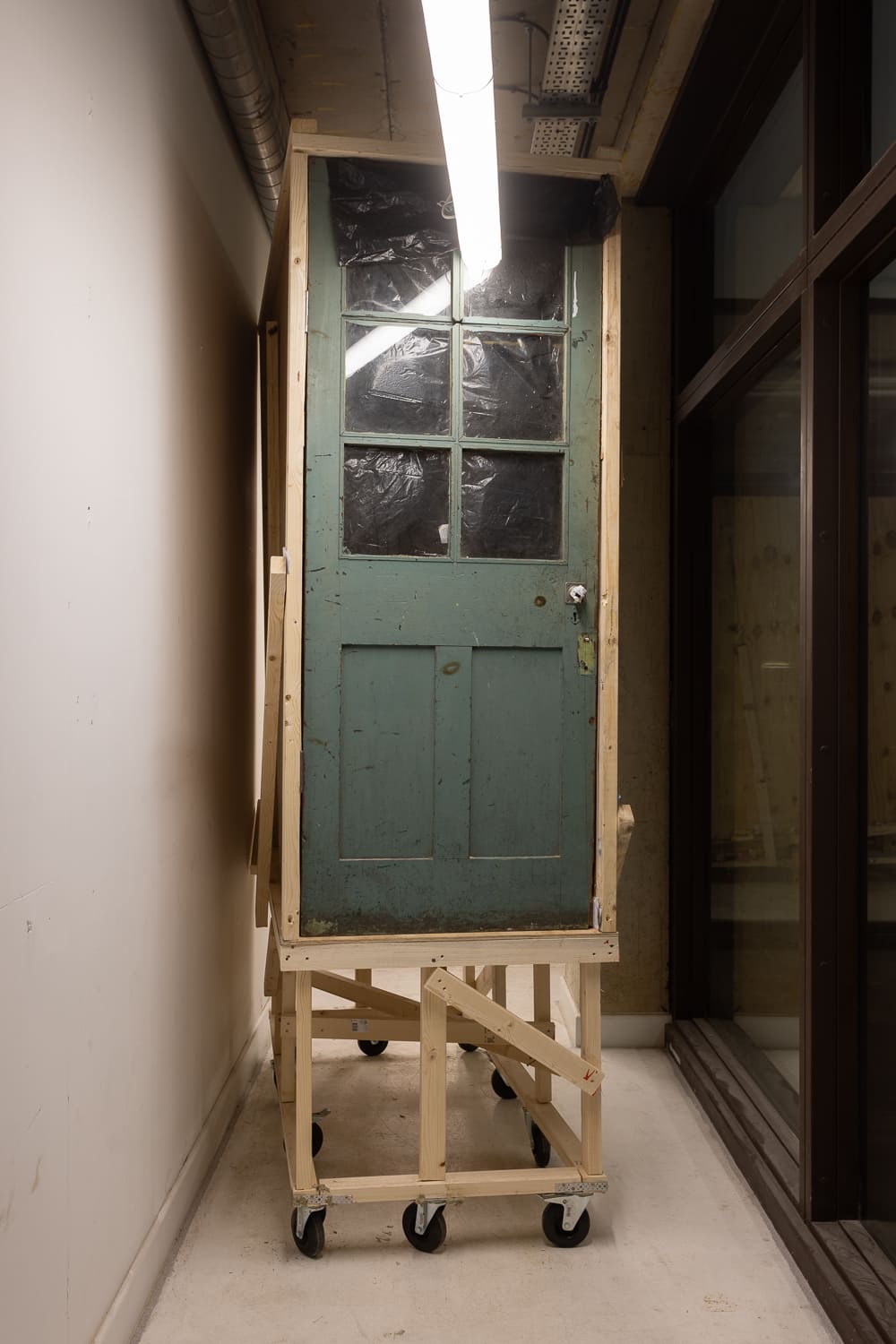
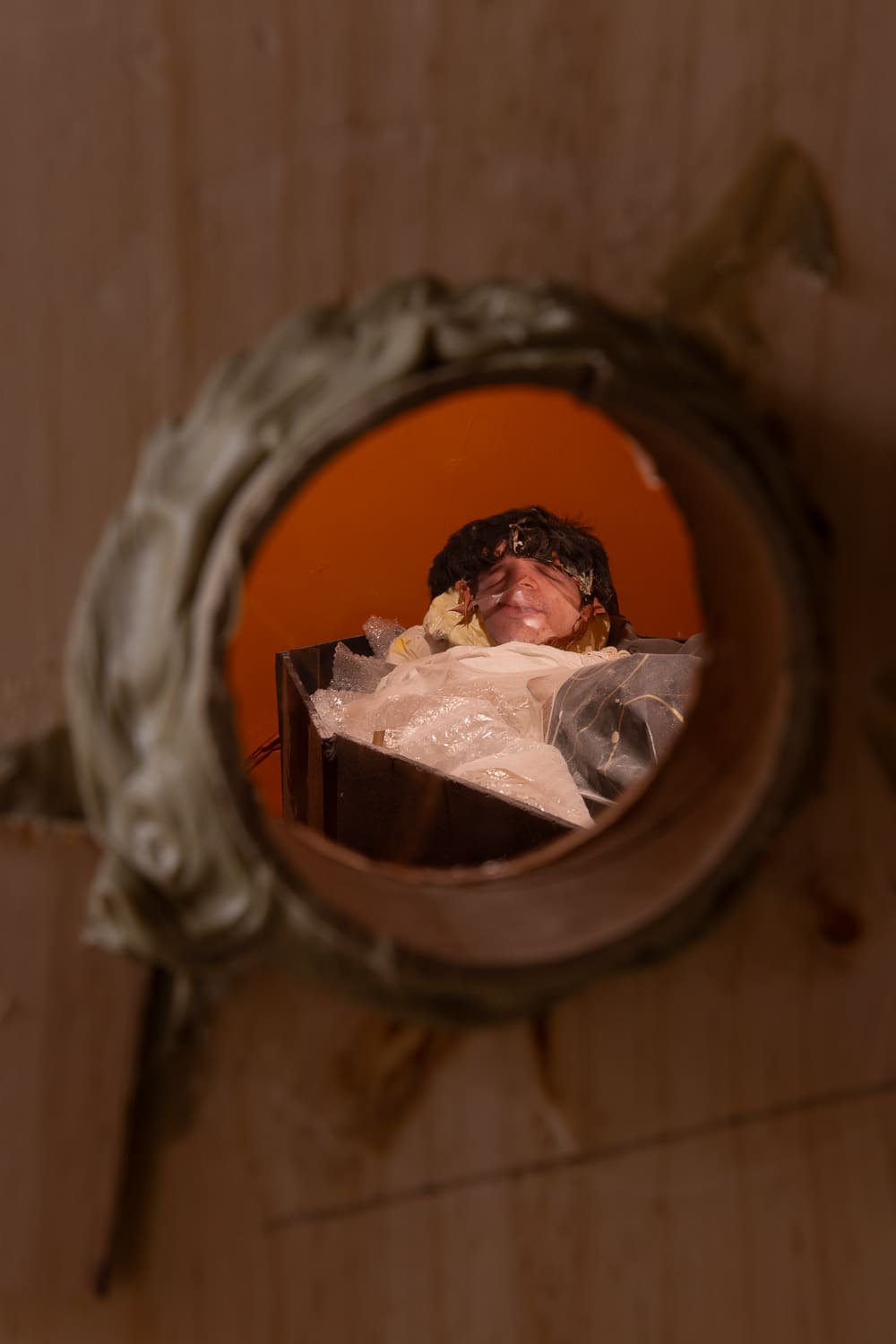
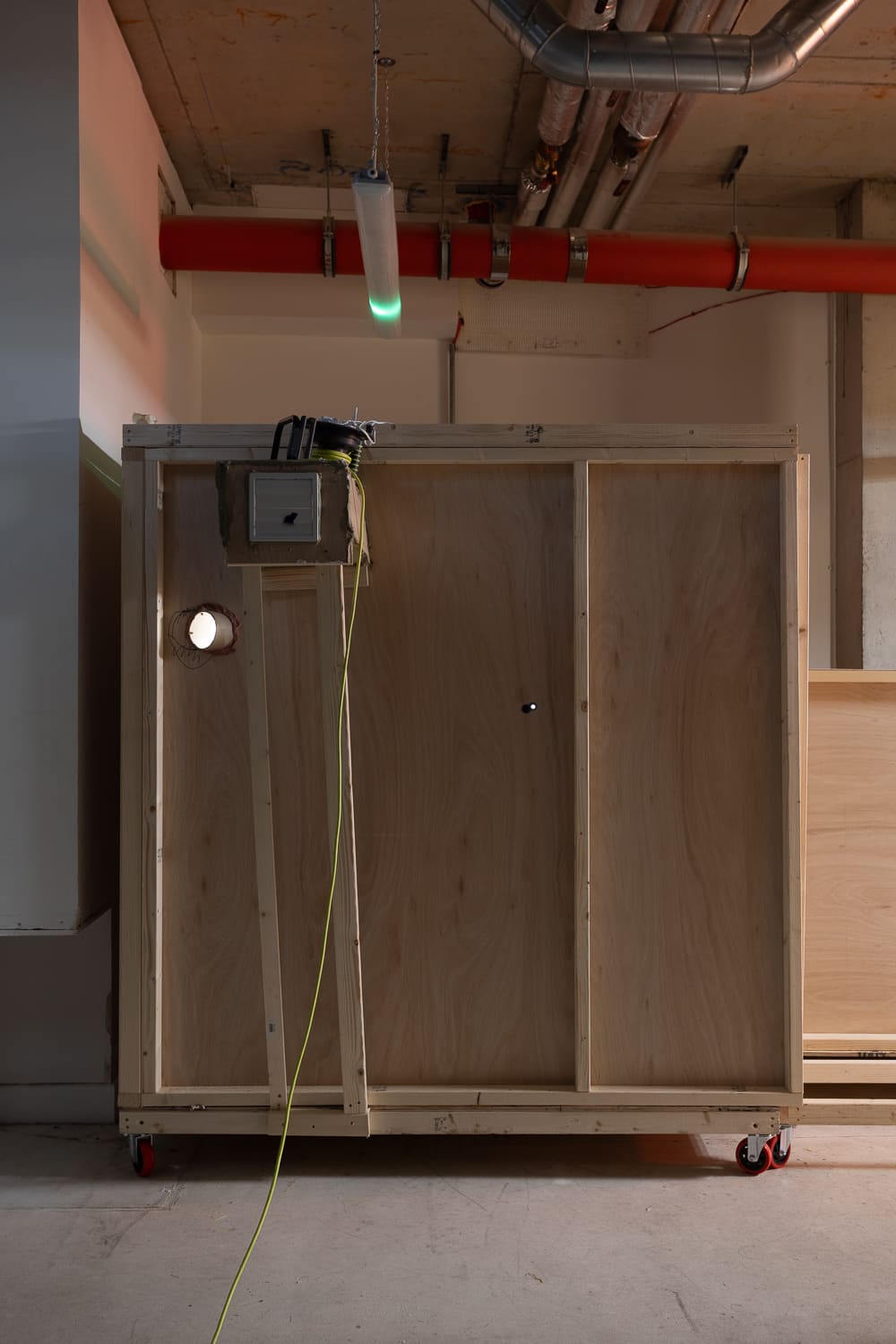
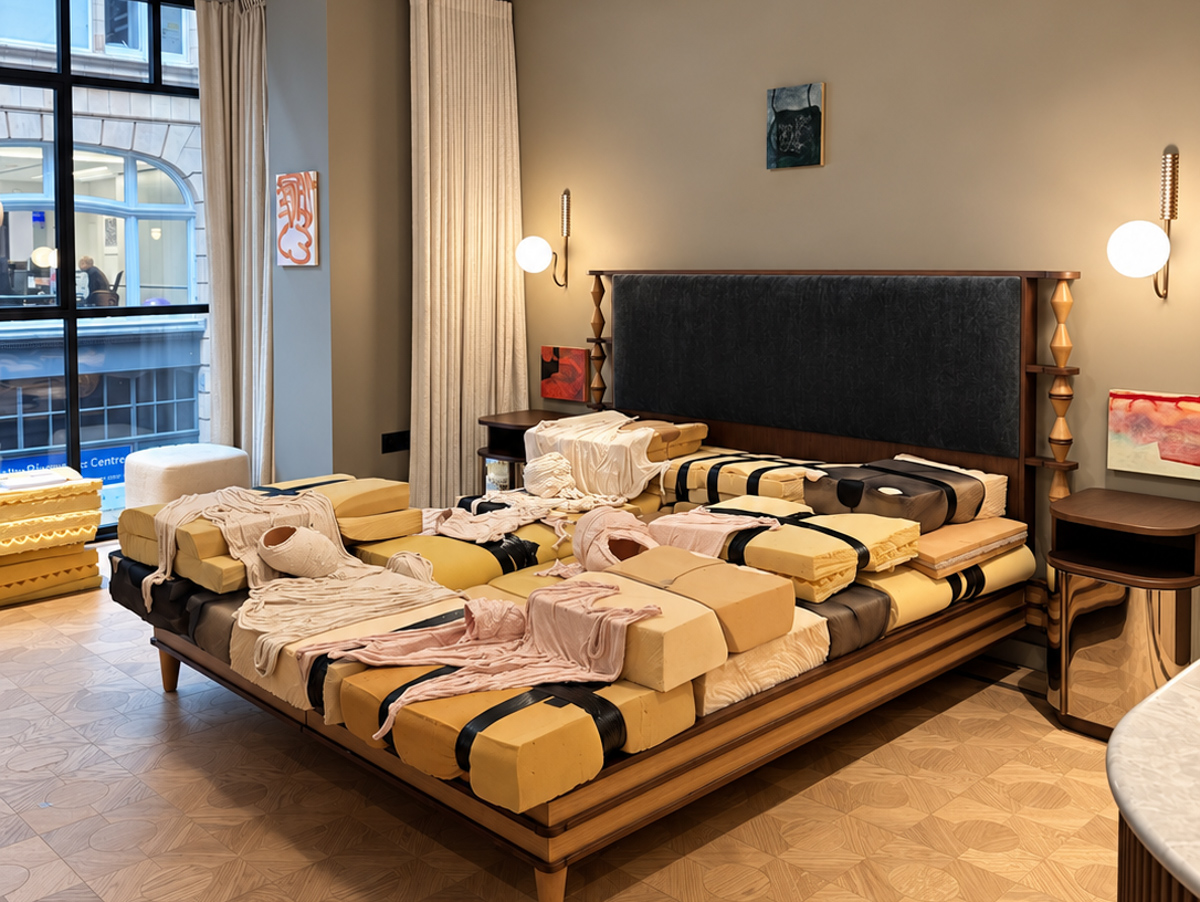
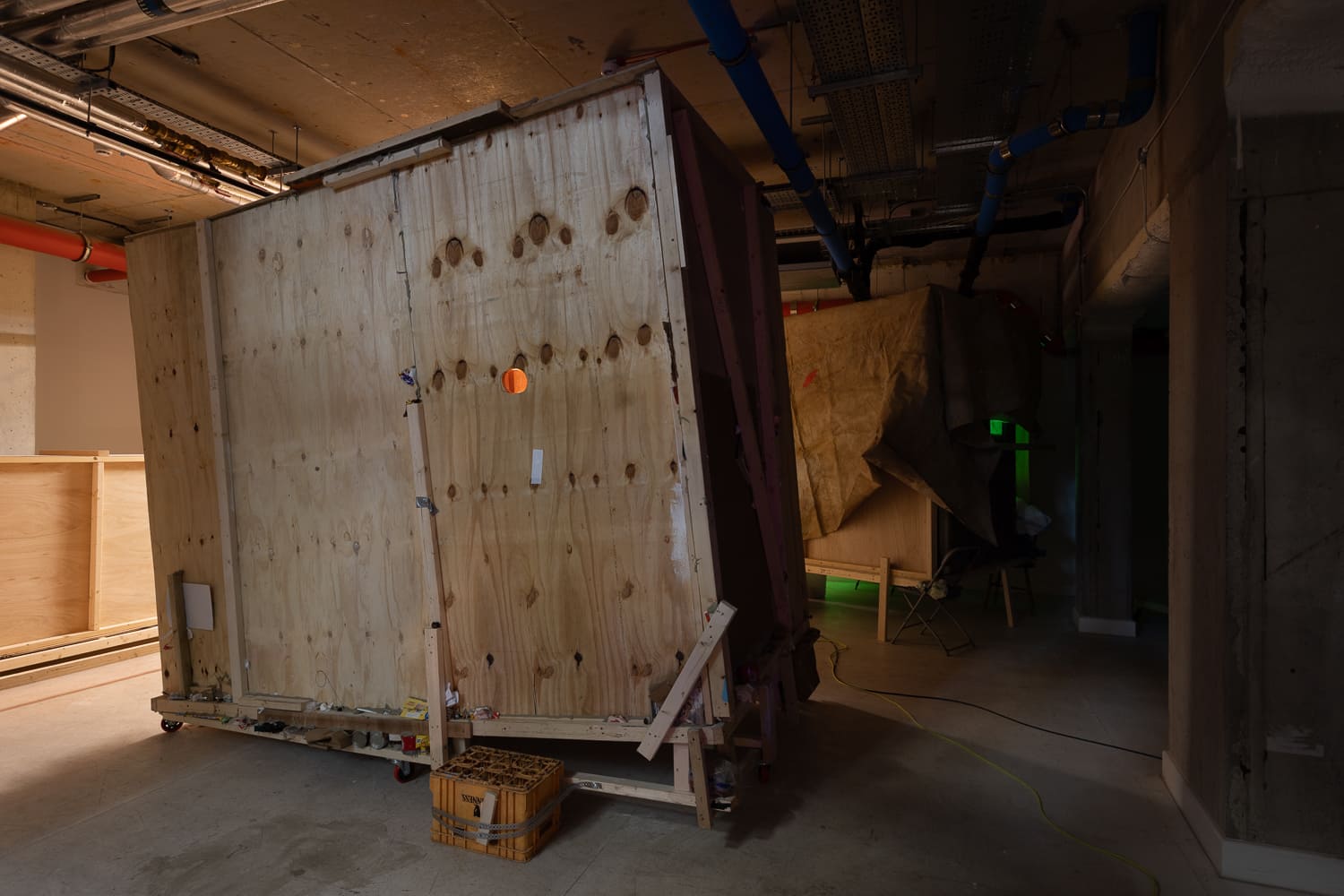
La instalación de Rory Mullen reúne una serie de entornos construidos: seis habitaciones sobre ruedas distribuidas por la galería, sin una secuencia fija. Estas estructuras no se dejan ver por completo. Se descubren de manera oblicua, a través de aperturas incómodas, grietas y mirillas, obligando al espectador a ajustar el cuerpo, inclinarse, buscar. El recorrido no está guiado, sino que se construye de forma autónoma. No hay una narrativa clara que seguir, sino una manera de atravesar el espacio guiada por el instinto y la incertidumbre.
La práctica de Mullen surge de su experiencia en el diseño escenográfico, donde los espacios se construyen para ser habitados y luego desmontados. Aquí, sin embargo, esa posibilidad desaparece. Las habitaciones permanecen cerradas, funcionando menos como entornos en los que entrar que como situaciones para observar, ofreciendo una visión que resulta a la vez íntima y estructuralmente imposible. El espectador ocupa una posición que no debería existir, mirando desde dentro de la arquitectura, en lugar de hacia ella.
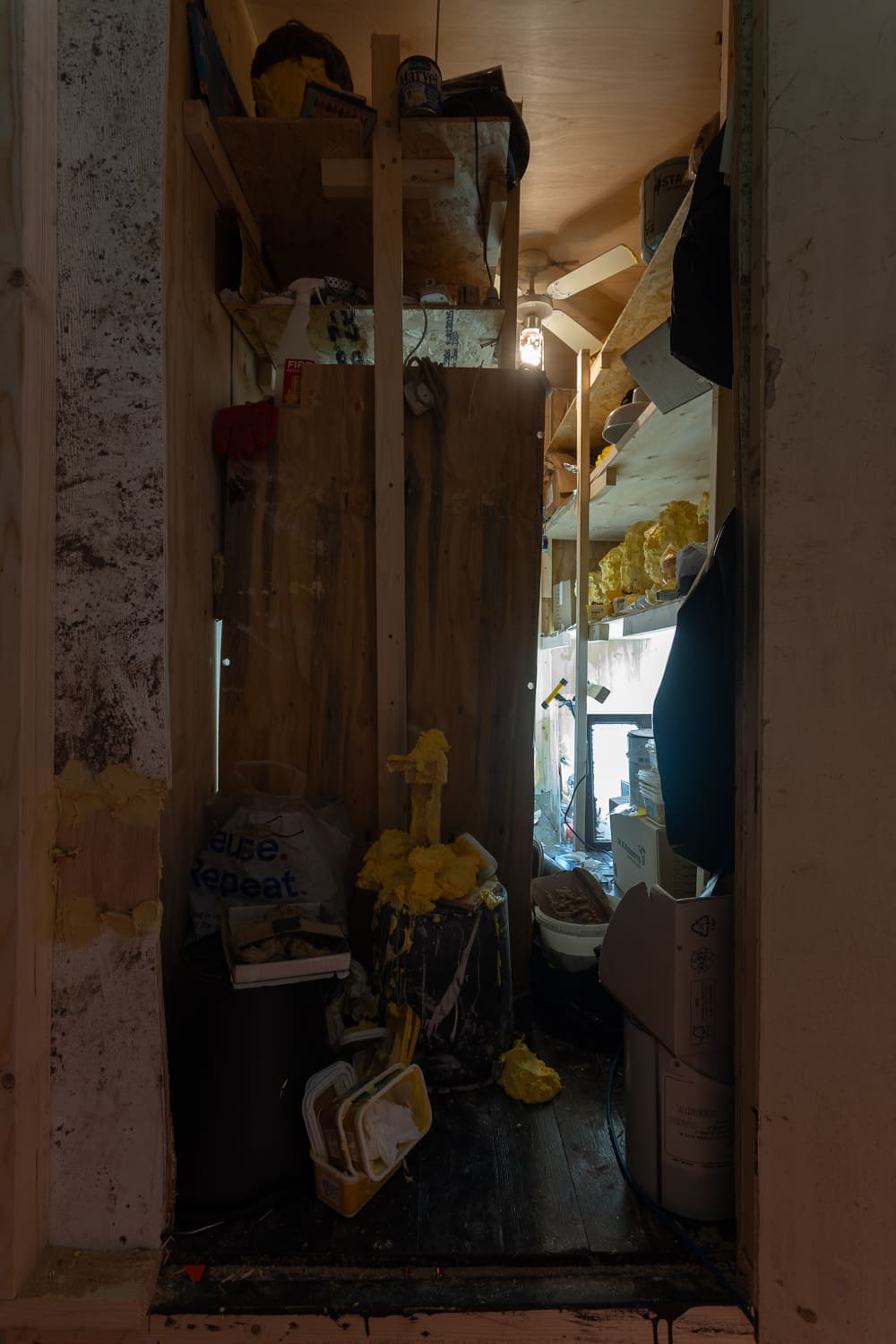
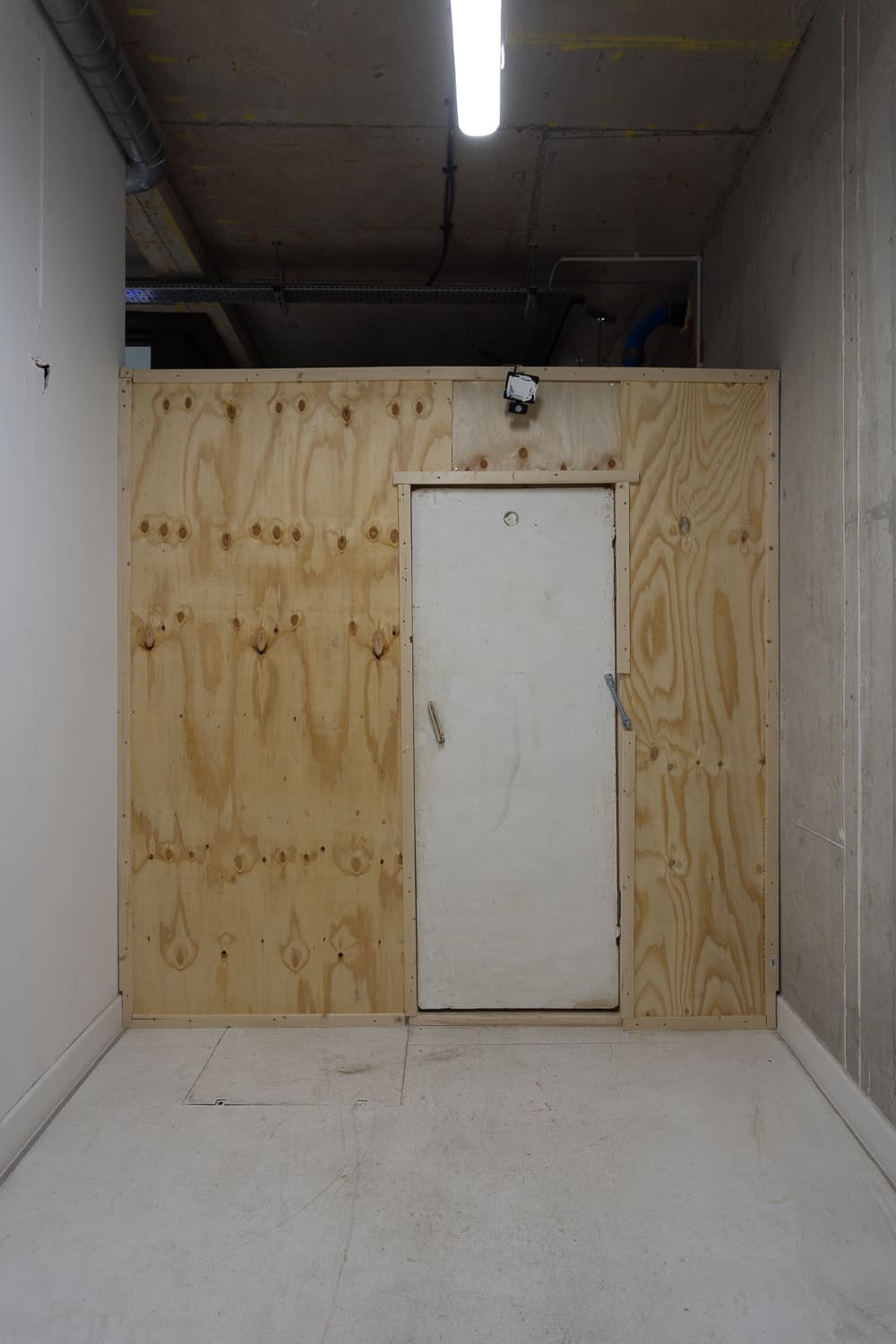
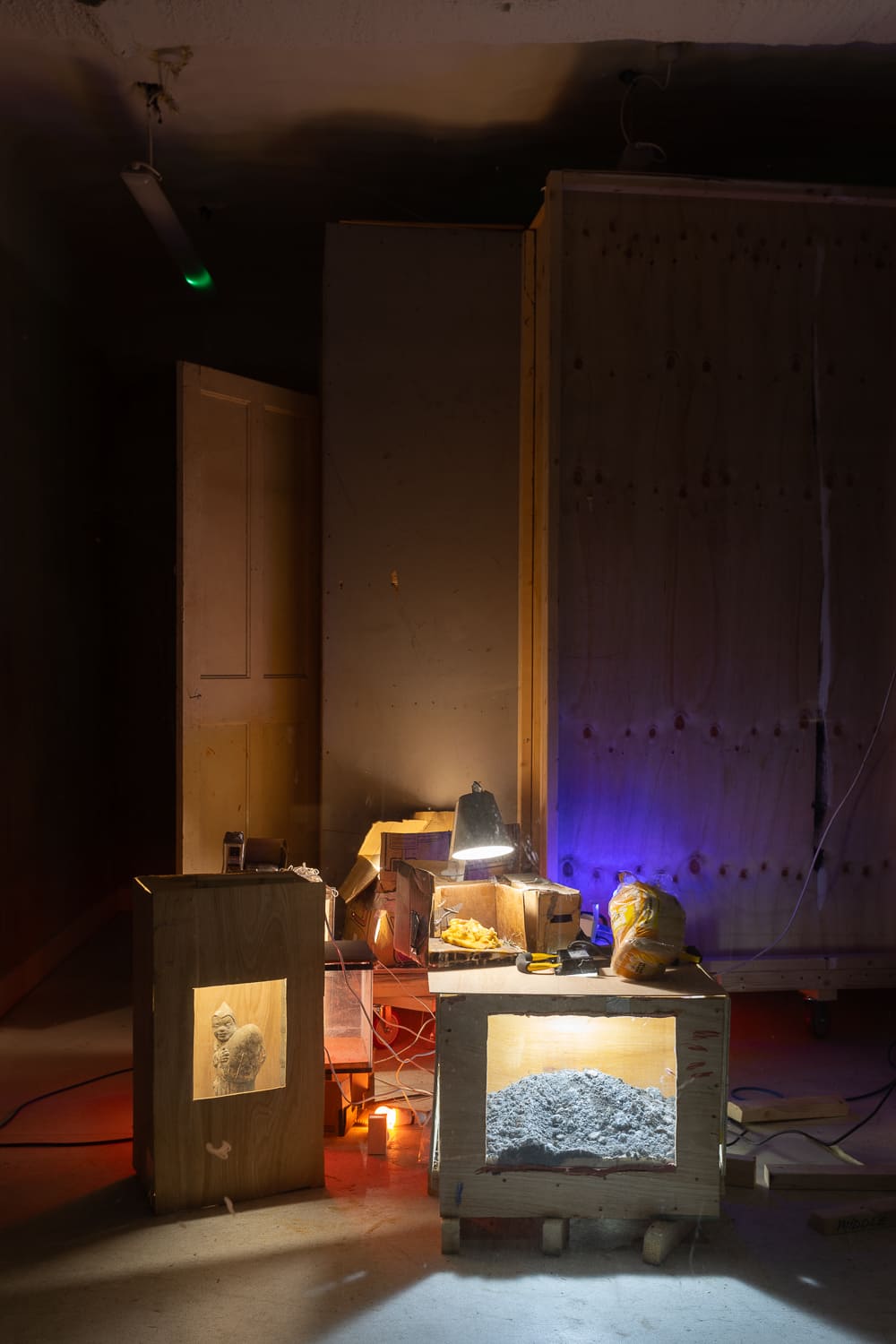
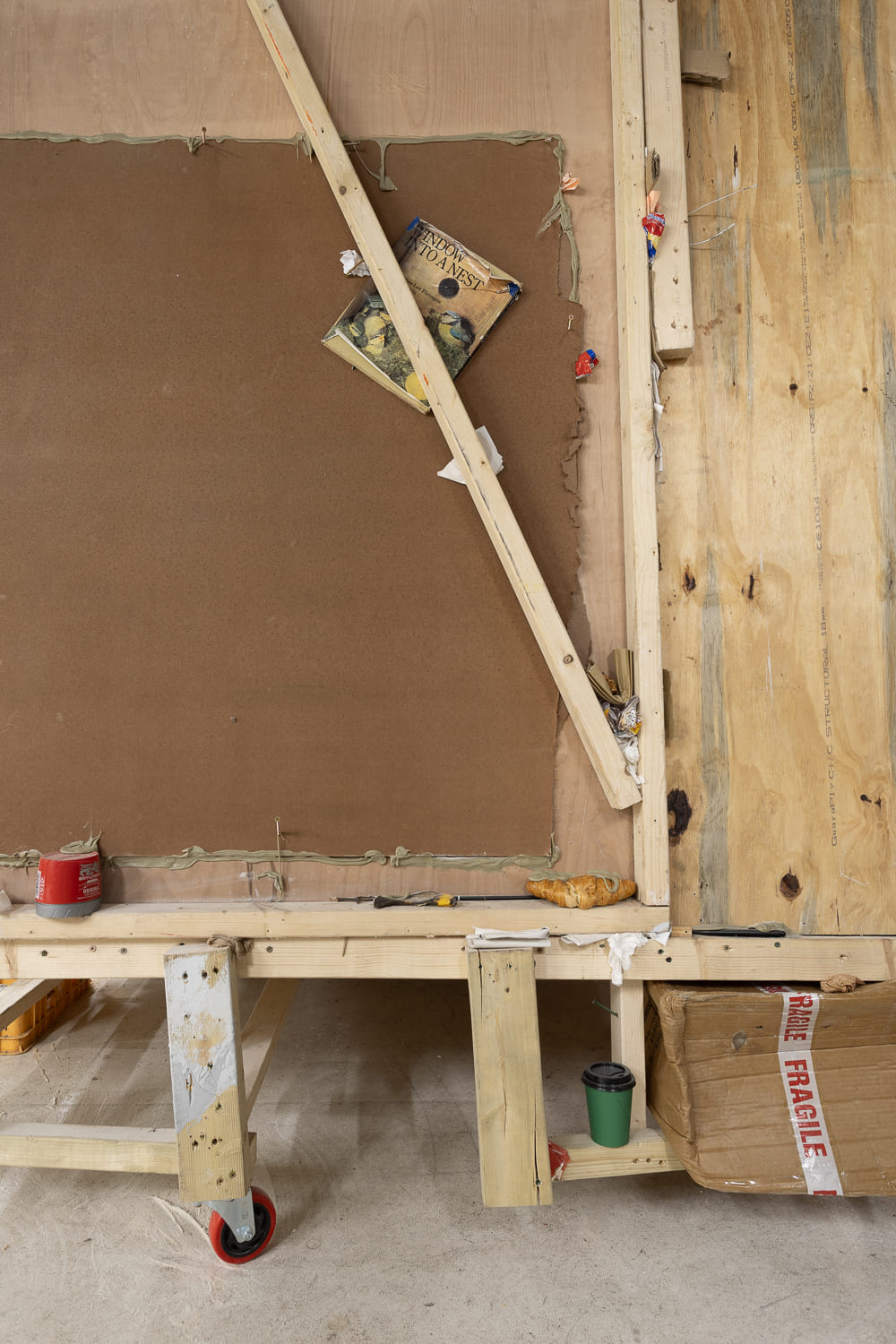
Construidos a partir de elementos recogidos y reutilizados, estos espacios conservan una huella de uso previo. Son estructuras provisionales, moldeadas por la acumulación más que por un diseño preconcebido, que sugieren que alguien ha estado allí, sin llegar a revelar quién, ni qué ocurrió.
La exposición se experimenta a través de fragmentos. Lo que queda es parcial, suspendido, nunca del todo resuelto. Durante una reciente visita a Londres, Kluid visitó la exposición y conversó con Mullen sobre la intrusión, la artificialidad y la construcción de entornos que permanecen fuera de alcance.
La exposición individual de Rory Mullen, On the Verge of Want, presentada por D/ARTS en Londres, estará abierta hasta el 3 de marzo.
Ver esta publicación en Instagram
CGR: La exposición comienza en una penumbra casi total, donde la luz y el sonido preceden a la forma. ¿Cómo pensaste ese primer momento de encuentro con el espectador?
RM: La intrusión juega un papel importante. Al principio, el espacio se siente casi como una obra en construcción; no estás del todo seguro de si deberías estar ahí o si siquiera es una exposición. La primera escultura interrumpe tu recorrido, bloquea ligeramente el paso, así que tienes que encontrar tu propio modo de avanzar.
Algunas personas ni siquiera estaban seguras de estar en el lugar correcto. Y una vez que lo entienden, aparece otra capa de incertidumbre: cómo mirar, cómo acercarse a las obras. La gente intenta entrar en los espacios y luego se da cuenta de que no puede. Ese momento de duda, de sentir que quizás estás en un lugar donde no deberías estar, es importante para mí.
CGR: Diseñaste la exposición sin una secuencia narrativa fija. ¿Qué tipo de experiencia sustituye a la narrativa?
RM: Pienso cada sección como un fragmento de una narrativa más amplia, pero nunca como algo completo. Siempre me han incomodado las obras que explican demasiado. Me interesan más las situaciones en las que el espectador tiene que descifrar las cosas por sí mismo, incluso si eso resulta desorientador.
No hay un principio, un desarrollo o un final claros. La experiencia se construye a partir de la confusión y el descubrimiento.
CGR: ¿Qué es lo que más te interesa de cómo el público se mueve por la exposición?
RM: Me gusta que resulte inquietante. La entrada funciona casi como un umbral hacia otro entorno. La gente suele reaccionar diciendo que hay “mucho” en el espacio, y solo poco a poco se da cuenta del nivel de detalle y del trabajo que hay detrás.
El recorrido es deliberadamente incómodo. No puedes planificarlo de antemano, y eso genera una cierta tensión. Casi parece que un organismo se hubiera soltado dentro del espacio.
Durante el montaje, los responsables del edificio pensaron que yo era un okupa; no entendían cómo había entrado todo. Ese momento, en el que la realidad y la ficción se confunden, es exactamente lo que me interesa.
CGR: ¿Qué significa para ti tratar la arquitectura como algo provisional o transportable?
RM: Mucho de esto viene de mi experiencia en escenografía. Construyo espacios, los desmonto y los transporto, a menudo en la parte trasera de una furgoneta. A diferencia de la arquitectura tradicional, estas estructuras nunca están pensadas para ser permanentes.
Aquí, las habitaciones están sobre ruedas, de modo que parecen haber venido de otro lugar, como fragmentos desplazados de otro contexto. Me interesa la idea de que una habitación, algo que asociamos con estabilidad, pueda ser en realidad temporal y móvil.
De alguna manera, estas obras funcionan como memorias portátiles. La mayoría de nuestras experiencias ocurren dentro de habitaciones, así que recrearlas y transportarlas se convierte en una forma de reconstruir esas experiencias.
Siempre me han interesado espacios como el estudio de Francis Bacon, que fue conservado y trasladado a Dublín. Hay algo muy potente en poder asomarse a un entorno tan íntimo.
CGR: Hay una intimidad en mirar a través de grietas y mirillas, pero también algo inquietante. ¿Qué te interesa de restringir el acceso?
RM: No lo pienso tanto como algo voyeurista; ese no es el objetivo. Más bien, las habitaciones funcionan como especímenes, algo dispuesto para ser observado en lugar de habitado, casi como una vitrina de museo.
El acto de mirar a través de estas aperturas cambia la forma en que ves. No es como mirar por una puerta o una ventana; es más controlado, más específico, como si se te dirigiera hacia una forma concreta de ver. Se acerca más a observar un espécimen, o incluso a una especie de diorama, donde el espacio se presenta como un fragmento construido, en lugar de algo que puedes recorrer.
Se te ofrece una vista que normalmente no sería posible, casi como si el espacio hubiera sido abierto para ti. Estás mirando desde una posición que no debería existir, desde donde debería haber una pared o una estructura. Eso es importante porque hace que el espacio se sienta más artificial, más escenificado, y no algo que puedas confundir con lo real.
CGR: El libro Window into a Nest es una de tus principales referencias y está incluido en la exposición. ¿Qué te impactó de él?
RM: Creo que es la idea de ver algo que en realidad no estás destinado a ver. En algo como un nido, hay partes que normalmente permanecen ocultas, cerradas o protegidas. El libro revela esos espacios interiores de una manera que se siente ligeramente antinatural.
Es similar al teatro, donde al espectador se le da acceso al retirar una pared. Pero aquí, la posición del espectador resulta aún más extraña, como si ocupara un lugar que nunca debería existir. No solo estás mirando hacia dentro, sino que estás mirando desde dentro de la estructura, desde el lugar donde debería haber materia. Es casi como una vista ampliada o en sección.
Podría haber construido las habitaciones como en el teatro y permitir que la gente entrara, pero el hecho de no poder hacerlo acentúa su artificialidad. Hay algo frustrante en ello; hay todo este esfuerzo y nivel de detalle, pero no puedes acceder ni resolver completamente lo que estás viendo. Esa tensión es importante.
CGR: Tu trabajo invita a una implicación física, incluso cuando restringe el acceso. ¿Cómo piensas ese equilibrio?
RM: Siempre me ha molestado lo intocable que puede ser el arte, cuando te dicen que no toques nada. Aquí quiero que la gente se involucre físicamente, que trepe, que ajuste su posición, que se mueva de forma incómoda.
Hay una ligera fricción en esa interacción, algo que desafía las expectativas. Es participativo, pero no de manera directiva; simplemente le pide algo al cuerpo para poder ver.
Tampoco quiero que la gente se lo tome demasiado en serio. Hay algo en hacer las cosas un poco mal, o en crear obras que se sientan ligeramente fuera de lugar, que genera una cierta tensión. Puede ser serio y absurdo al mismo tiempo. Pienso en Samuel Beckett en ese sentido, donde algo puede ser muy pensado pero también un poco ridículo. Me gusta que la gente tenga que esforzarse por entenderlo.
CGR: Trabajas con materiales recogidos y previamente utilizados. ¿Qué te atrae de esos materiales que ya tienen una historia?
RM: En parte es una cuestión de necesidad. Al crecer en el campo, usábamos lo que teníamos a mano, reutilizando materiales de garajes u objetos sobrantes. Esa forma de trabajar se ha quedado conmigo.
Me atrae la imperfección. Utilizar materiales que podrían considerarse basura va en contra de la idea de que algo tiene que ser limpio o nuevo para tener valor.
En mi trabajo escenográfico, reutilizo los mismos materiales una y otra vez, de modo que van acumulando una especie de historia. Me interesa esa sensación de una vida anterior contenida en el objeto.
Mi abuelo trabajaba de una manera similar. Hacía objetos funcionales con lo que tuviera a mano, sin pensar en ello como arte, simplemente haciendo lo necesario. Pero había algo increíblemente intuitivo en su forma de hacer. Era práctico, pero también profundamente considerado a su manera, y completamente desprovisto de pretensión.
Esa manera de trabajar definitivamente ha permanecido conmigo.
CGR: ¿Cómo decides cuándo una estructura está terminada, considerando su naturaleza inherentemente temporal?
RM: Es un equilibrio extraño. A veces tengo prisa por terminar, y otras siento que podría seguir trabajando indefinidamente.
Pero normalmente hay un punto en el que la idea se siente resuelta. Aunque haya elementos con los que no estoy completamente satisfecho, sé que añadir más no cambiará realmente la obra.
Para mí, algo puede estar terminado y aun así podría seguir añadiendo cosas, pero no haría ninguna diferencia. La idea ya está ahí. A partir de ese punto, se trata más de exceso que de necesidad.
CGR: ¿Qué te gustaría que permaneciera en el espectador después de salir de la exposición?
RM: Me interesa menos que la gente se vaya con una narrativa clara y más que se lleve una sensación persistente. Un estado de ánimo, o una energía que permanezca.
Idealmente, los espacios continúan existiendo en su memoria de una forma ligeramente inestable, algo que resulta familiar pero al mismo tiempo inquietante.
Dirección: 39 Gransden Avenue, London E8 3QA
Visitas: Con cita previa escribiendo a info@dartsldn.com
English Version
Rory Mullen’s solo exhibition On the Verge of Want, presented by D/ARTS in London, concludes on March 3.
There is a moment, just before assimilation, when a space resists discernment. Entering On the Verge of Want, one is met not with objects but with conditions: darkness, dispersed light, and the low murmur of sound. The exhibition does not immediately declare itself. Instead, it withholds, producing a slight bewilderment — a question of whether one has arrived too early, or perhaps somewhere not entirely meant for entry.
Rory Mullen’s installation comprises a series of constructed environments: six rooms on wheels distributed across the gallery, without a fixed sequence. These structures do not offer themselves fully. They are encountered obliquely, through awkward apertures, cracks, and peepholes, requiring the viewer to adjust their body, to lean, to search. Movement here is not guided but autonomous. There is no fixed narrative to follow, only a way of moving through the space by instinct and uncertainty.
Mullen’s practice emerges from a background in set design, where spaces are built to be inhabited and then dismantled. Here, however, inhabitation is denied. The rooms remain sealed, functioning less as environments to enter than as situations to observe, offering a view that feels both intimate and structurally impossible. The viewer is positioned in a place that should not exist, looking from within the architecture rather than into it.
Constructed from gathered and reused elements, these spaces carry a sense of prior use. They form provisional structures shaped by accumulation rather than design, suggesting that someone has been there, without ever resolving who, or what took place.
The exhibition is experienced through fragments. What remains is partial, suspended, and never fully resolved.
During a recent visit to London, Kluid visited the exhibition and spoke with Mullen about intrusion, artificiality, and the construction of environments that remain just out of reach.
CGR: The exhibition begins in near darkness, with light and sound preceding form. How did you think about the viewer’s first moment of encounter?
RM: Intrusion plays a big role. At the beginning, the space feels almost like a building site; you’re not entirely sure if you’re supposed to be there or if it’s even an exhibition. The first sculpture interrupts your path; it blocks you slightly, so you have to figure out how to move through the space on your own.
Some people weren’t even sure they were in the right place. And even once they realize they are, there’s another layer of uncertainty — how to look, how to approach the works. People try to enter the spaces and then realize they can’t. That moment of hesitation, of feeling like you might be somewhere you shouldn’t be, is important to me.
CGR: You designed the exhibition without a fixed narrative sequence. What kind of experience replaces narrative for you?
RM: I think of each section as a fragmented piece of a larger narrative, but never something complete. I’ve always had a problem with works that explain too much. I’m more interested in situations where the viewer has to work things out for themselves, even if that feels disorienting.
There’s no clear beginning, middle, or end. Instead, the experience builds through confusion and discovery.
CGR: What excites you most about how people move through the exhibition?
RM: I like that it feels unsettling. The entrance functions almost like a threshold into another environment. People often react by saying there’s “so much” in the space, and only gradually realize the level of detail and effort involved.
It’s intentionally awkward to navigate. You can’t pre-plan your route, and that creates a kind of tension. It almost feels like an organism has been let loose within the space.
During installation, the building managers came in and thought I was a squatter; they couldn’t understand how everything had been brought in. That moment, where reality and fiction blur, is exactly what interests me.
CGR: What does it mean for you to treat architecture as something provisional or transportable?
RM: A lot of this comes from my background in set design. I build spaces, dismantle them, and transport them, often in the back of a van. Unlike traditional architecture, these structures are never meant to be permanent.
Here, the rooms sit on wheels, so they feel like they could have come from somewhere else — fragments displaced from another context. I’m interested in the idea that a room, something we associate with stability, can actually be temporary and mobile.
In a way, these works function like portable memories. Most of our experiences happen inside rooms, so recreating and transporting them becomes a way of reconstructing those experiences.
I’ve always been drawn to spaces like Francis Bacon’s studio, which was preserved and relocated to Dublin. There’s something compelling about being able to peer into such an intimate environment.
CGR: There’s an intimacy in looking through cracks and peepholes, but also something unsettling. What interests you about restricting access?
RM: I don’t really think of it as voyeuristic; that’s not the goal. It’s more that the rooms function like specimens — something set up to be looked at rather than entered, almost like a museum display.
The act of peering through shifts how you see it. It’s not like looking through a door or a window; it’s more controlled, more specific, like you’re being directed into a particular way of seeing. It’s closer to looking at a specimen, or even a kind of diorama, where the space is presented as a constructed slice rather than something you can move through.
You’re given a view that wouldn’t normally be possible — almost like the space has been cut open for you. You’re looking from a position that shouldn’t exist, from where there should be a wall or structure. That’s important because it makes the space feel more artificial, more staged, rather than something you could mistake for being real.
CGR: The book Window into a Nest is one of your main inspirations and is included in the exhibition. What stayed with you from it?
RM: I think it’s the idea of seeing something you’re never really meant to see. With something like a nest, there are parts of it that are usually hidden, enclosed, or protected. The book reveals those interior spaces in a way that feels slightly unnatural.
It’s similar to theatre, where the audience is given access by removing a wall. But here, the position of the viewer feels even stranger — like you’re occupying a space that was never meant to exist at all. You’re not just looking in; you’re looking from within the structure, from the place where there should be material. It’s almost like a magnified or cutaway view.
I could have built the rooms more like a theatre and let people walk into them, but not being able to enter them heightens their falseness. There’s something frustrating about that; there’s all this effort and detail, but you can’t fully access or resolve what you’re seeing. That tension is important.
CGR: Your work invites physical engagement, even as it restricts access. How do you think about that balance?
RM: I’ve always disliked how precious art can feel, where you’re told not to touch anything. Here, I want people to engage physically — to climb, adjust their position, or move around awkwardly.
There’s a slight friction in that interaction, something that pushes against expectations. It’s participatory, but not in a directive way; it just asks something of your body in order to see.
I also don’t want people to take it too seriously. There’s something in doing things a bit badly, or making things that feel slightly off, that creates a kind of tension. It can be serious and absurd at the same time. I think of Samuel Beckett in that way, where something can feel very considered but also slightly ridiculous. I like that people have to work to figure it out.
CGR: You work with gathered and previously used materials. What draws you to materials that carry traces of past use?
RM: Part of it is necessity. Growing up in the countryside, we used what we had, repurposing materials from garages or leftover objects. That way of working has stayed with me.
I’m drawn to imperfection. Using materials that might be considered rubbish goes against the idea that something needs to be clean or new to have value.
In my set design work, I reuse the same materials repeatedly, so they accumulate a kind of history. I like that sense of a past life embedded in the object.
My grandfather worked in a similar way. He would make functional objects out of whatever was available, not thinking of it as art, just doing what was needed. But there was something incredibly instinctive in the way he made things. It was practical, but also deeply considered in its own way, and completely unprecious.
That way of working has definitely stayed with me.
CGR: How do you decide when a structure is complete, given its inherently temporary nature?
RM: It’s a strange balance. Sometimes I’m rushing to finish; other times I feel like I could keep working on something indefinitely.
But usually, there’s a point where the idea feels resolved. Even if there are elements I’m not entirely satisfied with, I know that adding more won’t fundamentally change the work.
For me, something can be complete and I could still keep adding to it, but it wouldn’t really make a difference. The idea is already there. After that, it’s more about excess than necessity.
CGR: What do you hope lingers with the viewer after they leave the exhibition?
RM: I’m less interested in people leaving with a clear narrative and more in a lingering sensation — a mood, or a kind of energy that stays with them.
Ideally, the spaces continue to exist in their memory in a slightly unstable way — something that feels familiar but also unsettled.
Location: 39 Gransden Avenue, London E8 3QA
Visits: By appointment via info@dartsldn.com